
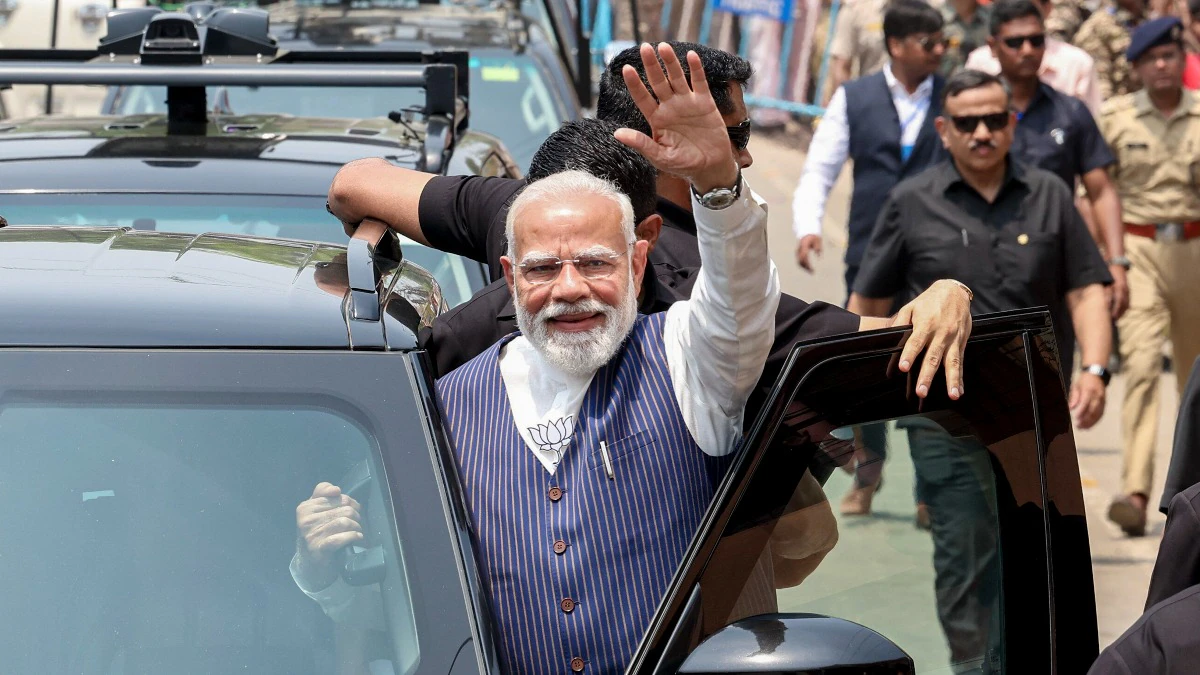
Prime Minister Narendra Modi has ordered a 50% reduction in his official convoy size and directed the Special Protection Group (SPG) to maximise the use of electric vehicles in his security fleet, without purchasing new vehicles. The directive, confirmed on May 13, 2026, follows a series of seven public appeals Modi made at a rally in Hyderabad on May 10, urging citizens to reduce petrol and diesel consumption, avoid non-essential foreign travel, postpone gold purchases, embrace carpooling and public transport, and shift to electric vehicles wherever possible.
The convoy reduction was visible in practice during the Prime Minister’s subsequent visits to Gujarat and Assam, where the number of vehicles in his motorcade was significantly lower than previous occasions. Within 48 hours of Modi’s directive, several BJP chief ministers followed suit. Uttar Pradesh CM Yogi Adityanath ordered a 50% reduction in convoy sizes for himself and all state ministers. Delhi CM Rekha Gupta ordered curbs on official vehicles used by ministers and MLAs, and also urged residents to carpool. Rajasthan CM Bhajanlal Sharma was seen moving in a reduced cavalcade of five vehicles. Madhya Pradesh CM Mohan Yadav similarly ordered reductions in official vehicle usage.
This is not a policy announcement. It is a behavioural signal from the highest office in the country, delivered at a moment when the economic case for EVs has never been more visceral or more urgent.
The Crisis Behind the Signal
India imports approximately 87% of its crude oil requirements. In 2025-26, crude oil imports cost the country $134.7 billion, making it by far the single largest item in India’s import bill. Gold imports added another $72 billion, vegetable oils $19.5 billion, and fertilisers $14.5 billion. Together, these four categories account for over 31% of India’s total imports.
The escalating conflict in West Asia has placed the Strait of Hormuz, through which approximately 20% of the world’s energy supply transits, under severe disruption risk. The consequence for India has been immediate and sharp: crude oil prices rose from an average of $70.99 per barrel in FY2025-26 to $114.48 per barrel in April 2026 and $105.4 per barrel in May 2026. Every dollar increase in crude price costs India approximately $1.6 billion in additional annual import expenditure. At current price levels relative to the FY2026 average, India’s annual crude import bill has expanded by over $60 billion in a matter of weeks.
The government has taken several pre-emptive steps. Excise duties on petrol and diesel were reduced by Rs 10 per litre in March 2026 to cushion domestic retail prices. Export duties on diesel and aviation fuel were raised to protect domestic supply. India has diversified its crude sourcing across approximately 40 countries by March 2026 and has been increasing purchases from Russia as Middle Eastern supply grew uncertain. Oil marketing companies are absorbing significant financial pressure daily to keep domestic pump prices stable. But that freeze is, by most analyst assessments, unsustainable if global prices remain at current levels.
Modi’s appeal is, at its core, a demand management intervention. As the Daily Pioneer calculated, a 3% saving on crude consumption equals approximately $5 billion saved, equivalent to one month of war-related forex pressure absorbed. A 25% reduction in non-essential foreign travel equals roughly $10 billion. A 15% cut in gold imports equals another $10 billion. Voluntary civilian restraint across these three categories, if achieved even partially, could delay fuel price hikes by several months and protect millions of households from a cost-of-living shock that no subsidy could fully offset.
The EV Signal and What It Means
The SPG directive to maximise EV use without new purchases is a carefully calibrated message. It signals commitment without extravagance, conservation without expenditure. From a market perspective, the visible use of EVs in the Prime Minister’s security convoy, even if initially limited to existing fleet vehicles, creates a category of endorsement that is impossible to manufacture through advertising.
Several BJP leaders have already extended the symbolism further. BJP representatives have been photographed using the metro and e-rickshaws to attend events, making the public transport and EV messaging visible at the ward and constituency level, not just at the national level.
For India’s EV industry, the implications are layered. In the near term, the fuel price anxiety that Modi’s appeals have made explicit strengthens the total cost of ownership argument for every EV segment, from electric two-wheelers for daily commuters to electric trucks for fleet operators calculating per-kilometre running costs. In the medium term, if domestic petrol prices are eventually decontrolled partially to reflect global reality, the TCO advantage of EVs widens overnight. The political signalling around EVs from the highest level of government is unlikely to diminish in that environment.
The risk in the near term is that the same economic stress which makes EVs more attractive in TCO terms also makes the upfront cost harder to absorb for middle-income buyers already facing inflation pressure. Government subsidy continuity under PM E-DRIVE and state-level incentive frameworks will be the critical variable that determines whether the demand signal translates into actual sales volume through the rest of FY2027.
What Comes Next
The domestic fuel price situation is the single most consequential near-term variable for India’s EV market. If the government maintains the retail price freeze, the TCO argument for EVs remains strong but not dramatic. If prices are decontrolled even partially, the case for EVs becomes structurally undeniable for any buyer who covers more than 40-50 km per day.
The West Asia situation, and its trajectory through the Strait of Hormuz, is outside India’s control. What is within India’s control is how quickly it reduces the share of its mobility energy that comes from imported crude. India surpassed its renewable energy targets ahead of schedule. The EV transition, if sustained at the current growth rate of 18% annually, could meaningfully reduce crude demand within the decade. Modi’s convoy directive will not by itself move that needle. But it has placed the most powerful symbol in Indian public life on the right side of that ledger, and that is rarely insignificant.
India’s EV story has always been about economics. For the first time, it is also unmistakably about national security.