
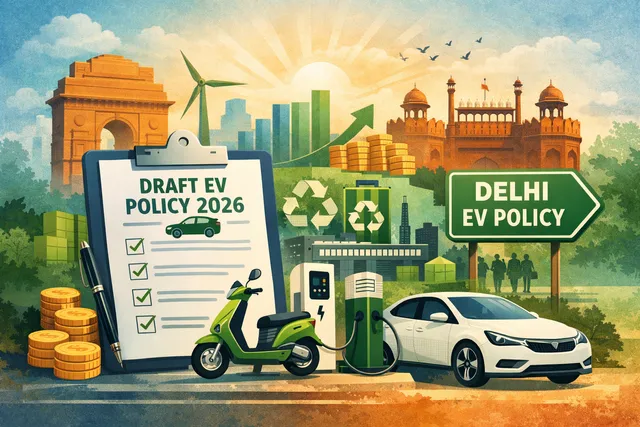
The Draft Delhi Electric Vehicle Policy 2026-30, placed in the public domain on April 11, 2026, received nearly 700 responses during its 30-day stakeholder consultation, which closed on May 10, 2026. Delhi Transport Minister Pankaj Kumar Singh confirmed the tally on Monday, noting that over 400 submissions came from the general public, including individual residents, vehicle owners, commuters, Resident Welfare Associations, students, delivery riders, and gig workers. Around 200 submissions were received from industry stakeholders spanning OEMs, OEM associations, charge point operators, battery swapping operators, vehicle scrappers, battery recyclers, discoms, and fleet aggregators. More than 50 responses came from institutions including schools, NGOs, think tanks, universities, and international policy organisations. Around a dozen submissions were received from government departments, ministries, and statutory authorities.
“The overwhelming response received from citizens, industry stakeholders, institutions, and experts reflects Delhi’s collective aspiration towards a cleaner, greener, and future-ready mobility ecosystem,” the Minister said, adding that suitable recommendations will be incorporated to make the policy more robust and inclusive before it is officially notified.
The sheer breadth of respondents, from individual gig workers to national ministries, reflects the policy’s ambition. This is not a niche document for EV enthusiasts. It is a framework that, once notified, will bind every fleet aggregator, every school, every government department, and every two- and three-wheeler buyer in the national capital for the next four years.
Policy Momentum
The Draft Delhi EV Policy 2026-30 builds on the foundation laid by Delhi’s original 2020 EV policy, which helped the capital achieve approximately 14% EV adoption in new vehicle registrations by 2025, nearly double the national average of 8% over the same period. The new draft marks a decisive shift in approach: from incentivising early adopters through financial subsidies to mandating a system-wide transition across vehicle categories, fleet types, and institutional procurement.
The policy was notified with a total budgetary outlay of approximately Rs 3,954 crore for the 2026-30 period, with the 2026-27 budget alone allocating Rs 320 crore for depot electrification and public charging infrastructure and Rs 200 crore for EV policy implementation. It aligns with the central government’s PM E-DRIVE scheme, under which Delhi is procuring 2,800 electric buses in Phase 1, targeting a total of 7,500 electric buses including 5,800 electric by March 2027 and 12,000 electric buses by 2029.
The constitutional framing matters here. The draft policy explicitly positions transport electrification as a response to the constitutional right to clean air and a pollution-free environment, a framing that has legal implications for how enforcement and compliance obligations are treated, particularly for institutional and commercial fleet operators.
The Mandates: What Changes and When
This is where the draft policy departs most significantly from its predecessors. Previous Delhi EV policies were primarily incentive frameworks with aspirational targets. The 2026-30 draft introduces hard regulatory mandates with specific effective dates.
From January 1, 2026 (already effective): Fleet aggregators and delivery service providers are prohibited from inducting new conventional ICE vehicles running purely on diesel or petrol into their four-wheeler LCV, four-wheeler N1 category goods vehicle, and two-wheeler fleets. BS-VI two-wheelers are allowed to be inducted until December 31, 2026, after which the full ban applies.
From January 1, 2027: Only electric three-wheelers will be eligible for new registrations in Delhi. This is a complete ban on new CNG and petrol auto-rickshaw registrations.
From April 1, 2028: Only electric two-wheelers will be eligible for new registrations in Delhi. Every new scooter and motorcycle registered in the capital after that date must be electric.
Government fleet (from date of notification): All vehicles hired or leased by Delhi government departments, bodies, and institutions will be electric, with exceptions only for emergency or specifically exempted vehicles. All new intra-state buses inducted by Delhi Transport Corporation will be electric. All new N1 trucks purchased, leased, or hired by government departments and autonomous bodies will be electric.
School buses (phased mandate): 10% electrification by the end of year two, 20% by the end of year three, and 30% by March 2030, with the Education Department mandated to monitor compliance across the school bus fleet.
The phased mandate structure is what WRI India, which supported the Delhi government in developing the policy, describes as a decisive shift from the incentive-heavy approach of earlier frameworks to an enforceable mandate architecture that creates stable, predictable demand for EV manufacturers and infrastructure providers.
The Incentive Structure
The draft also lays out a tapering financial incentive structure designed to front-load adoption while progressively reducing subsidy dependency as the market matures.
Electric two-wheelers priced up to Rs 2.25 lakh (ex-factory) are eligible for purchase incentives of up to Rs 30,000 in Year 1 (Rs 10,000 per kWh of battery capacity), declining to Rs 20,000 in Year 2 and Rs 10,000 in Year 3. A scrapping incentive of up to Rs 25,000 is available for buyers who scrap a BS-IV or older petrol two-wheeler.
Electric three-wheelers (L5M auto-rickshaw category) receive Rs 50,000 in Year 1, Rs 40,000 in Year 2, and Rs 30,000 in Year 3, with scrapping incentives available for replacing older CNG or petrol auto-rickshaws.
Electric N1 trucks receive purchase incentives of Rs 1,00,000 in Year 1, Rs 75,000 in Year 2, and Rs 50,000 in Year 3, targeting the logistics and last-mile freight segment.
Electric cars priced up to Rs 30 lakh (ex-showroom) receive 100% exemption on road tax and registration charges until March 31, 2030. EVs priced above Rs 30 lakh receive no exemption. Strong hybrid vehicles receive a 50% exemption. A scrapping incentive of up to Rs 1,00,000 is available for individuals purchasing a new electric car after scrapping a BS-IV or older vehicle.
All purchase incentives will be delivered through Direct Benefit Transfer (DBT) to Delhi residents who register the vehicle in the capital, replacing the previous process where buyers often waited months for subsidy disbursals.
Infrastructure Architecture
Delhi Transco Limited has been designated as the nodal agency for public charging and battery swapping network planning and rollout, with a single-window clearance process for charger installation applications. OEMs will be required to install charging facilities at their dealerships. Battery recycling compliance falls under the Battery Waste Management Rules 2022, with the Delhi Pollution Control Committee responsible for enforcement.
The policy also mandates battery traceability through unique Battery Pack Aadhaar Numbers (BPAN), aligned with the national guidelines issued by the Ministry of Road Transport and Highways, enabling end-to-end tracking of battery life from production through recycling.
Notably absent from the draft is a provision for building-level charging infrastructure, a gap flagged by WRI India as a structural weakness. The previous Delhi EV policy included provisions for EV-ready parking in residential and commercial buildings. The 2026 draft removes those provisions, leaving home charging access, already at only 55% penetration nationally, without a policy mandate to improve it in a city where apartment-dwellers make up a significant share of EV buyers.
What the Numbers Actually Mean
Delhi’s 14% EV adoption rate in FY2025 was the highest of any major Indian city, achieved under the 2020 policy’s incentive-heavy framework. The question the 2026 draft is asking is whether the same momentum can be sustained, and accelerated, through mandates rather than just subsidies.
The answer from the 700-response consultation suggests genuine public engagement, but the distribution of responses is telling. With 400 submissions from the public and only 200 from industry stakeholders, the document going into final drafting carries stronger individual citizen representation than commercial fleet operator input. Whether that balance shifts before notification, and how the government weighs gig worker concerns about mandate timelines against industry requests for longer transition windows, will determine how the final policy looks.
WRI India’s analysis identifies EV financing as the single most structurally significant gap the policy does not adequately address. Interest rates of 15-20% on commercial EV loans, combined with weak secondary markets and residual value uncertainty, mean that fleet mandates without parallel financial de-risking mechanisms shift compliance costs onto small operators, including auto drivers and delivery gig workers, who are least equipped to absorb them.
What Comes Next
The consultation closed on May 10, 2026. The Transport Department will now review the 700-plus submissions, incorporate suitable recommendations, and finalise the policy for official notification. No notification date has been announced. Once notified, the policy runs until March 31, 2030.
The most immediate impact will be on the auto-rickshaw and two-wheeler market. With the three-wheeler ban effective from January 2027, dealers and OEMs have approximately seven months from today to complete any backlog of CNG auto registrations, after which the segment converts entirely to electric in Delhi. For two-wheeler buyers planning a purchase in 2027, the April 2028 deadline creates a narrow window for a final petrol bike registration. Beyond that date, Delhi’s two-wheeler market is electric by law.
That is not an aspiration. It is a deadline, and it is now 23 months away.