
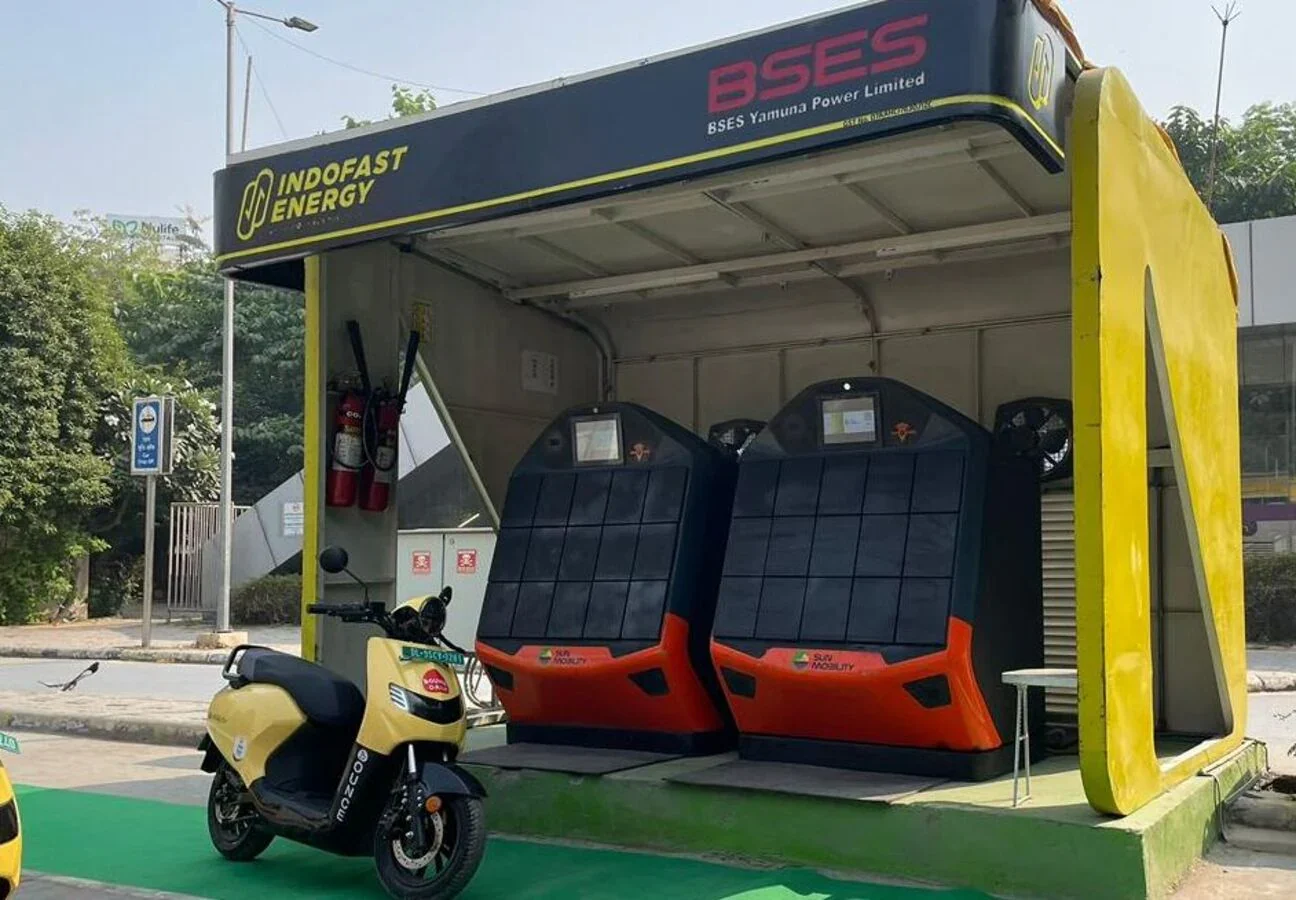
India’s largest battery swapping network just posted its most consequential year on record. Indofast Energy closed FY2026 with over 1,600 swap stations across 23 cities, more than 90,000 electric vehicles onboarded to its platform, and a cumulative travel enablement figure of 1.6 billion kilometres of electric mobility in a single fiscal year. The carbon arithmetic behind that number is equally striking: an estimated 80,000 tonnes of CO2 emissions avoided in FY2026 alone.
For an infrastructure category that was still being debated as recently as three years ago, these figures mark a decisive shift. Battery swapping in India is no longer a pilot. It is a functioning ecosystem serving the country’s most demanding real-world EV use case: the gig economy delivery rider who cannot afford 45 minutes of downtime for a conventional charge.
What Indofast Energy Actually Is
Indofast Energy is a 50:50 joint venture between IndianOil Corporation Limited (IOCL) and SUN Mobility, two organisations that bring complementary strengths to the battery-swapping model. IOCL’s existing fuel retail network provides a ready-made physical footprint for station deployment, while SUN Mobility contributes the technology stack and operational expertise behind the Battery-as-a-Service (BaaS) model. Under BaaS, EV operators do not purchase a battery outright. Instead, they pay for energy consumed on a per-swap or subscription basis, significantly reducing the upfront cost of EV ownership and shifting battery maintenance responsibility away from the rider entirely.
The two-minute swap time that anchors the model’s commercial appeal is what separates it fundamentally from conventional charging in a fleet context. A delivery rider completing 15-18 orders per day cannot absorb a charging stop. A swap stop costs the same time as a tea break.
Policy Momentum
India’s battery swapping segment has benefited from a supportive regulatory environment that has matured considerably since the government first signalled its intent to enable swapping as an alternative to fixed charging. The central government’s PM E-DRIVE scheme, which succeeded FAME II, includes provisions for battery swapping infrastructure alongside conventional public charging, acknowledging the distinct operational needs of commercial two-wheeler and three-wheeler fleets. The Bureau of Energy Efficiency (BEE) has been working toward interoperability standards for swap batteries, a development that, when finalised, would allow any compatible EV to use any operator’s swap station regardless of battery brand.
Indofast’s partnerships with Indian Railways, BESCOM (Bangalore’s power distribution utility), and the Mumbai Metro Rail Corporation (MMRC) to deploy stations at transit hubs and high-footfall locations signal a convergence between public infrastructure and private EV operations that is both strategically significant and practically durable. Stations at railway terminals and metro stations serve exactly the kind of high-throughput, time-sensitive rider who benefits most from sub-two-minute swaps.
Ground-Level Proof
The scale of Indofast’s FY2026 network did not arrive suddenly. The company commissioned its 1,000th station in September 2025, at the Lokmanya Tilak Terminus in Mumbai, describing it at the time as the fastest build-out of swap infrastructure of that scale in the country. By the end of FY2026, that figure had grown to 1,600 stations across 23 cities, meaning the company added 600 stations in roughly six months.
The fleet partners feeding volume through that network include Zypp Electric, Shadowfax, Rapido, Whizz, bluwheelz, and Loadshare, among others. These are not pilot customers. They are production-scale operators running thousands of daily deliveries for quick commerce platforms, food delivery apps, and e-commerce fulfilment chains. Their continued and expanding reliance on the Indofast network is arguably the most credible proof point available for the model’s operational viability.
Indofast also crossed 32 OEM partnerships in FY2026, a figure that reflects the growing willingness of vehicle manufacturers to design products around swap-compatible battery formats rather than treating swapping as an afterthought.
Segment Snapshot
Electric two-wheelers (E2Ws) remain the primary volume driver across Indofast’s swap network, consistent with their dominance in last-mile delivery fleets across Indian cities. The two-minute swap cycle is most impactful in this category, where the density of daily rides and the relatively small battery size make frequent top-ups a natural operational pattern.
Electric three-wheelers (E3Ws) represent the second-largest segment on the platform, with fleet operators in auto-rickshaw and goods-carrier categories benefiting from the removal of battery cost from the vehicle acquisition equation. For an operator purchasing an e-rickshaw on EMI, separating the battery cost through a subscription model can reduce the monthly ownership burden by a meaningful margin.
The company’s BaaS model also extends to small commercial four-wheelers, though this segment remains early-stage relative to the two and three-wheeler volumes.
OEM and Partner Performance
Indofast’s 32 OEM partnerships in FY2026 represent a significant broadening of the company’s vehicle compatibility. Earlier in its lifecycle, the network’s utility was constrained by the limited number of vehicles physically designed to accept its swap-compatible batteries. As that number grows, the network effect strengthens: more compatible vehicles on the road mean more demand per station, improving the economics of each station for operators and investors alike.
Among individual partnership milestones, the Quantum Energy collaboration to deploy the Bziness XS electric scooter through the Indofast network, the EVeez partnership targeting 20,000 e-bikes across Tier-1 and Tier-2 cities, and the Greaves Electric Mobility integration for swap-compatible scooters all reflect the growing mainstreaming of BaaS as a product design consideration rather than an optional feature.
The company’s franchise programme, launched in December 2025, offers entrepreneurs a path to set up swap stations with an investment ranging from Rs 10 lakh to Rs 40 lakh across three formats: Swap Point, Swap Hub, and Swap Junction. Projected returns range from 1.7x to 2.7x on investment, with annual return estimates of up to 30%. With more than 200 franchise partner stations already operational across 12 cities as of that launch, the programme is designed to accelerate geographic expansion beyond what a purely company-owned network could achieve.
What Comes Next
Indofast’s stated target heading into FY2026 was 2,750 swap stations and 1.5 lakh vehicles by March 2026. The company closed FY2026 at 1,600 stations and 90,000 vehicles, which means it fell short of its station target by roughly 40% while reaching 60% of its vehicle target. That gap is worth examining honestly: rapid infrastructure build-out in a new category consistently runs into permitting, real estate, and grid interconnection timelines that are difficult to accelerate through capital alone.
The long-horizon target remains considerably more ambitious. Indofast has outlined plans for 10,000 swapping points across more than 40 Indian cities within the next three years, which would represent a roughly sixfold expansion from current levels. Achieving that at the pace required will depend on the franchise programme gaining traction, OEM compatibility broadening further, and interoperability standards from BEE enabling cross-platform use.
The risk that could slow progress most materially is not demand: gig economy growth in India shows no sign of decelerating, and fuel price pressure continues to make the TCO argument for electric delivery vehicles stronger each quarter. The risk is standardisation. As long as different battery swapping operators run proprietary battery formats, the ecosystem remains fragmented and riders face compatibility constraints when switching vehicles or employers. A national interoperability standard, when it arrives, would likely be the single most consequential policy development for this segment since FAME II.