In 2016, when Arjun Madra returned to India from Australia, the country’s electric vehicle ecosystem was barely a sketch. There were no structured distribution networks, no reliable service chains, and almost no public awareness about electric three-wheelers beyond the basic awareness that they existed. The e-rickshaw segment, now a cornerstone of urban last-mile transport, was operating largely in the informal economy without organised players to bring it coherence.
Arjun saw none of that as a deterrent. He saw a market that hadn’t been built yet.
“I started looking for options with a grand vision,” he says, “something that could create a real impact on the Indian market.”
That vision became GEV, and in 2026, as the company completes a decade in operation, its footprint tells its own story: over 20,000 electric vehicles sold, a dealer network of 100-plus touchpoints across India, and thousands of livelihoods directly empowered through its vehicles.
A Global Beginning with a Deeply Local Instinct
Born in Durgapur and raised in Noida, Arjun pursued his undergraduate studies at Amity University before moving to Australia for a double master’s degree. By most measures, the trajectory ahead of him was straightforward: build a career abroad, climb steadily, stay comfortable. But comfort wasn’t what he was optimising for.
“I was always more inclined towards generating jobs instead of doing one,” he says, with the kind of plainness that makes it clear this wasn’t a rehearsed line.
It was during a visit home that he began seriously exploring the EV space. What he encountered was an industry in its infancy, particularly in the e-rickshaw segment, where neither the product nor the business model had been formalised. Rather than walking away from the ambiguity, he walked straight into it.
Starting Without a Playbook
Arjun is candid about what he didn’t have when he started GEV: a technical degree, industry contacts, or a proven roadmap. What he did have was a clear sense of who he was building for.
“Passion doesn’t need a degree,” he says. “If you can’t do something, hire the best person to do it.”
That philosophy shaped GEV’s early operating model. Instead of trying to master every dimension of EV engineering himself, Arjun focused on the people his vehicles would serve, specifically drivers, fleet operators, and small entrepreneurs running daily livelihoods on thin margins. He and a small team spent significant time in the field, personally selling vehicles, riding along with customers, gathering feedback, and iterating.
“I spent a lot of time on the field, understanding what really helps riders benefit,” he says.
That ground-up approach produced something more durable than a product: it produced a company that understood its customers at a level that most competitors, focused on engineering specs and distribution targets, never quite achieved.
“Success in EV is not just about engineering. It’s about solving real livelihood problems at scale.”
The Advantage of Having No Map
The absence of a playbook in those early years was, paradoxically, one of GEV’s greatest assets. “There were no playbooks,” Arjun reflects. “It forced me to learn directly from the ground.”
In a sector as unstructured as India’s early e-rickshaw industry, founders who relied too heavily on precedent often ended up building for a market that didn’t exist yet, or worse, for one that was already shifting. GEV’s relentless field orientation kept it calibrated to real demand, real constraints, and real geography.
There were moments of doubt, as there are in any first-generation venture. But Arjun treats those moments less as obstacles and more as tools for sharpening direction. “If your vision is strong and rooted in real impact, doubt doesn’t stop you. It sharpens you.”
Ten Years, 20,000 Vehicles, and a Clearer Definition of Success
GEV’s tenth anniversary marks a milestone that goes beyond the commercial. The company has sold over 20,000 electric vehicles, expanded its dealer and after-sales network to more than 100 locations, and supported thousands of families whose daily income depends on the vehicles it manufactures.
That last dimension is what Arjun returns to when asked what the numbers actually mean to him. “Each vehicle represents a livelihood, a family, a daily income. That’s what truly brings me joy.”
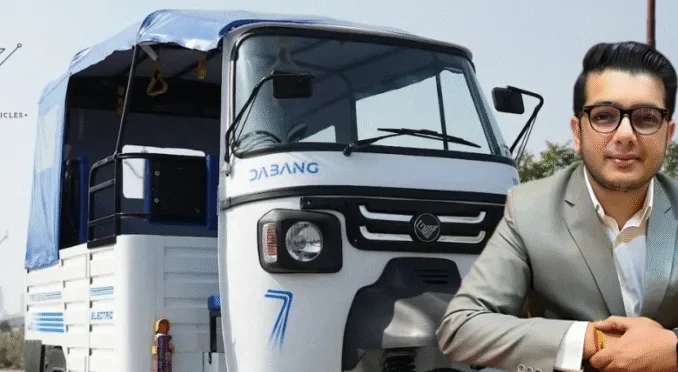
Among GEV’s notable product milestones is India’s first 7+1 electric auto, a vehicle configuration that expands passenger capacity per trip and directly improves unit economics for drivers. For operators calculating earnings per kilometre, that kind of product thinking matters considerably more than certificate range figures on a spec sheet.
“We don’t just build EVs. We build solutions that improve livelihoods.”
What GEV’s Story Means for India’s EV Ecosystem
GEV’s journey is a useful counterpoint to the dominant narrative around India’s EV sector, which tends to concentrate on consumer passenger cars, high-profile startup funding rounds, and large OEM announcements. The e-rickshaw and electric three-wheeler segment, which now accounts for the single highest EV penetration rate of any vehicle category in India, was built largely by first-generation founders like Arjun who entered an unstructured market without institutional backing and learned by doing.
That generation of founders arguably did more to normalise electric mobility in Indian cities than any single policy announcement. They put vehicles on roads, created service networks in Tier-2 and Tier-3 cities, and demonstrated that electric last-mile transport was commercially viable at the ground level, long before the sector became a priority for large capital.
The Lesson He Carries Forward
If there is one thing Arjun Madra consistently emphasises in reflecting on GEV’s first decade, it is accessibility: the idea that you do not need perfect knowledge or a flawless pedigree to build something meaningful.
“You don’t need to have all the answers. You need clarity on the problem you want to solve.”
It is advice that is easy to say and genuinely hard to live by in a sector as technically complex and operationally demanding as electric mobility. GEV’s decade of existence is the evidence that Arjun did, in fact, live by it.
“Don’t let your background limit your ambition.”
As India accelerates toward its clean mobility targets, the e-rickshaw and electric three-wheeler segment that GEV helped shape will remain central to the story. For the millions of drivers who earn their daily income behind the wheel of an electric vehicle in Indian cities, the most consequential EV founders were never the ones with the biggest funding rounds.
They were the ones who showed up early, stayed on the ground, and built for the person, not the press release.