
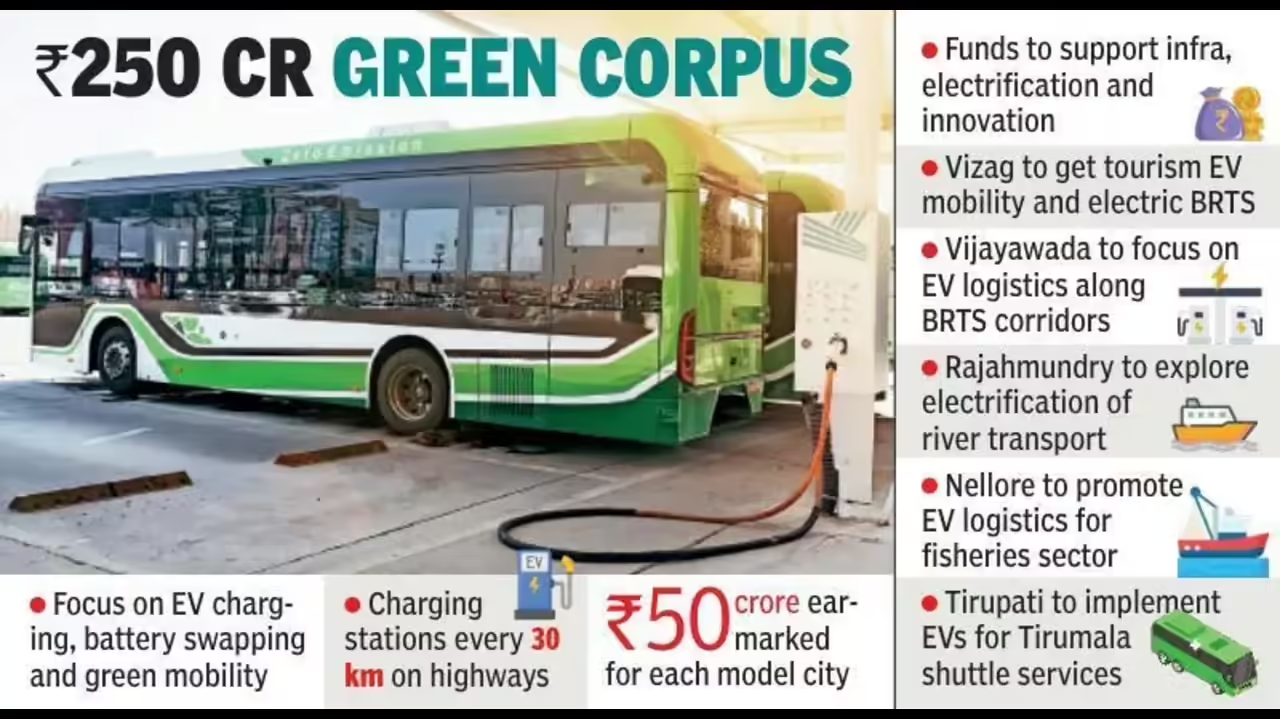
The Government of Andhra Pradesh notified five model E-Mobility cities on May 1, 2026, operationalising the Andhra Pradesh Sustainable Electric Mobility Policy (4.0) for the period 2024 to 2029 and backing it with a dedicated Rs 250 crore Corpus Fund, with Rs 50 crore earmarked per city. The five cities, Visakhapatnam, Rajahmundry, Vijayawada, Nellore, and Tirupati, each represent one of the state’s five administrative regions and will serve as pilot hubs where the full framework of EV infrastructure, green urban transport, and zero-emission mobility systems gets tested and scaled before state-wide rollout.
The Municipal Administration and Urban Development Department approved the Operational Framework and Strategic Roadmap for implementation across Urban Local Bodies (ULBs). The long-term target is unambiguous: carbon neutrality in the transport sector by 2047.
What Makes This Policy Different
Most state EV policies in India follow a familiar template: announce subsidy percentages, set registration targets, promise charging station counts, and wait for private capital to do the heavy lifting. AP’s E-Mobility Policy 4.0 takes a materially different approach by designing city-specific interventions that match the unique geography, economy, and mobility pattern of each chosen city rather than applying a uniform framework across all five.
That distinction matters considerably for implementation. A charging station grid that works in Vijayawada’s dense urban core does not automatically translate to Rajahmundry’s river-dependent economy or Tirupati’s pilgrimage-driven transport demand. The state government appears to have understood this, and the city-specific proposals in the operational framework reflect that understanding.
The initiative also aligns directly with national frameworks. AP’s policy sits alongside the central government’s PM E-DRIVE scheme and the broader push under the National Electric Mobility Mission to accelerate EV infrastructure in Tier-1 and Tier-2 cities, positioning the state to access central funding channels in addition to its own Rs 250 crore corpus.
The Five Cities and What Each One Gets
Visakhapatnam (North Andhra) has been earmarked for green tourism mobility, electric Bus Rapid Transit System (BRTS) corridors, and green freight corridors. As the state’s largest city and a growing industrial and port hub, Vizag’s EV plan integrates commercial freight, public transit, and tourism in one framework, reflecting the city’s multi-dimensional mobility challenge.
Vijayawada (Central Andhra) will receive model green routes along BRTS corridors and logistics-focused EV infrastructure. As one of the state’s most commercially active cities and a major goods transit point, the focus on logistics electrification is well-matched to Vijayawada’s dominant economic character.
Rajahmundry (Godavari Region) gets electrification of river transport systems alongside green goods corridors, a proposal that stands out nationally as one of the few state-level EV plans to explicitly address inland waterway transport. If executed, this could position Rajahmundry as a genuine national case study for electric river mobility.
Nellore (South Andhra) has been assigned EV logistics systems for fisheries and coastal transport infrastructure. The fisheries angle is particularly specific: fish transport in coastal districts currently runs almost entirely on diesel, and electrifying that cold-chain corridor would have significant fuel cost and emission implications for one of AP’s most economically important industries.
Tirupati (Rayalaseema) receives arguably the most visible mandate: full electrification of Tirumala shuttle systems and the creation of Zero Emission pilgrim mobility zones. With Tirumala drawing tens of millions of pilgrims annually, a fully electric shuttle corridor between Tirupati and the temple town would be among the highest-footprint single interventions in any Indian city’s EV plan.
The Infrastructure Architecture
The Operational Framework proposes a charging infrastructure network built on two spatial standards. Within each E-Mobility city, one EV charging station per 3×3 km grid will be developed, ensuring that no urban resident is more than a short distance from a charging point. Along inter-city Green Channels and highways connecting the five cities, one EV charging station every 30 km will be established, enabling electric vehicles to complete inter-city journeys without range anxiety.
Beyond conventional charging, the framework includes battery swapping stations, zero emission zones (ZEZs), and Dedicated City E-Mobility Cells (CEMCs) in each city. CEMCs are a notable addition: dedicated institutional units within each city’s Urban Local Body to oversee implementation, coordinate stakeholder activity, and monitor progress against targets. Their inclusion suggests the state is trying to build governance capacity alongside physical infrastructure, addressing one of the most common reasons EV policies fail at the city level.
The phased implementation covers electric public transport systems, renewable energy integration for EV charging, smart urban mobility planning, and green freight corridors, all designed to work as an integrated ecosystem rather than standalone interventions.
The Rs 250 Crore Question
The corpus fund allocation of Rs 50 crore per city is significant in signalling seriousness, but it is worth contextualising against the scale of what is being proposed. A 3×3 km charging grid across an entire city, river transport electrification, BRTS corridor electrification, and zero emission zones collectively represent capital requirements that go well beyond Rs 50 crore per city.
The fund is better understood as viability gap funding and seed capital, designed to de-risk early infrastructure deployment and attract private investment into the ecosystem rather than to fund the entire build-out from public resources. The framework explicitly mentions viability gap funding and consumer adoption initiatives among the uses of the corpus, suggesting the state is using public money to close the first-mover risk gap, not to own the infrastructure outright.
Whether private capital follows at the scale required will depend significantly on how quickly the CEMCs become functional, how transparent the project tendering process is, and whether the state’s track record on infrastructure delivery in previous schemes gives investors confidence in execution.
Why This Matters Beyond Andhra Pradesh
Andhra Pradesh’s five-city model is structured to be replicable. By concentrating the full stack of EV infrastructure in five geographically and economically distinct cities, the state is running five parallel experiments simultaneously. Visakhapatnam’s freight corridor learnings can inform other industrial port cities. Tirupati’s pilgrim mobility model can be adapted for Varanasi, Haridwar, or Amritsar. Rajahmundry’s river transport intervention, if successful, becomes a template that no other state has yet built.
That replicability is what elevates this notification beyond a state-level policy announcement. If even three of the five cities execute their city-specific mandates to a meaningful degree by 2027, AP’s E-Mobility Policy 4.0 could become the reference document for how Indian states design place-specific EV transitions rather than issuing generic targets and hoping private investment does the rest.
The carbon neutrality target of 2047 is a 21-year horizon. The five model cities are the first measurable chapter in that story. Whether the chapter is written well depends on what happens in the next 18 to 24 months of actual ground-level implementation.