India’s electric small commercial vehicle (e-SCV) segment delivered 1,817 units in April 2026, a 200% jump year-on-year, making it the undisputed growth engine of the country’s electric commercial vehicle (e-CV) market, according to retail data tracked by Autocar Professional. The broader e-CV category clocked its second-highest monthly sales ever at 2,236 units, marking 148% YoY growth (April 2025: 903 units). In a market where most segments celebrate 30-40% growth, these numbers belong to a different conversation entirely.
The April performance is significant not just for the absolute volumes but for what it reveals about the structural forces reshaping urban freight in India. Small electric cargo carriers are no longer a niche experiment. They are fast becoming the default choice for last-mile delivery operators across e-commerce, FMCG, cold-chain, and organised retail.
Policy Momentum
The e-SCV segment’s rapid growth is unfolding against a backdrop of consistent policy support, even as the category matures beyond its subsidy-dependent early years. The central government’s PM E-DRIVE scheme continues to extend incentives for electric commercial vehicles, particularly in the light goods carrier category that serves urban logistics. The Production Linked Incentive (PLI) scheme for Advanced Chemistry Cell (ACC) batteries is steadily reducing India’s import dependence on battery packs, which directly supports the cost competitiveness of electric small trucks versus their diesel counterparts.
At the state level, several major markets including Maharashtra, Delhi, and Rajasthan have maintained or expanded registration fee waivers and road tax exemptions for electric commercial vehicles, effectively lowering the on-road acquisition cost for fleet operators. For businesses running delivery fleets at scale, these incentives combined with dramatically lower per-kilometre running costs are making the economics of e-SCVs increasingly difficult to argue against.
An accelerating tailwind is the ongoing global crude oil supply crisis. With diesel prices under pressure globally, operators running 80-150 km of urban routes daily are actively accelerating their transition timelines to lock in energy cost certainty.
Ground-Level Proof
The April data is backed by a rapidly expanding portfolio of purpose-built electric cargo vehicles. Across the nearly 40 players in the e-CV space, product depth has improved significantly over the past 18 months, with OEMs now offering multiple payload configurations, battery sizes, and body lengths within the same vehicle platform, allowing fleet operators to match the right specification to their specific route and cargo requirements.
Infrastructure for commercial EV operations, including depot charging solutions and fleet management platforms, has also matured considerably, reducing a key barrier that previously made fleet electrification operationally complex for mid-sized logistics companies.
Segment Snapshot
Electric small commercial vehicles (e-SCVs) dominated the April e-CV mix with 1,817 units and an 81% segment share, the category’s most emphatic month yet. The 200% YoY growth rate is particularly notable given that the comparable base in April 2025 was not especially low.
Electric buses came in second within the e-CV basket, with state transport undertakings and municipal corporations procuring 342 units, representing 23% YoY growth. While bus volumes remain modest relative to the SCV category, steady procurement from government fleets continues to sustain a reliable demand floor for bus OEMs.
Electric heavy goods carriers, typically deployed for infrastructure and industrial applications, recorded 77 units in April, up 267% YoY, though off a small base. This segment remains early-stage but the growth trajectory suggests expanding use cases in construction and industrial logistics.
The January-April 2026 cumulative tally for e-SCVs already stands at 6,498 units, a 184% increase over the same period in 2025, and represents 60% of the full-year CY2025 record. If the current trajectory holds, the segment is on course to exceed 20,000 units in CY2026, nearly double the 10,772 units sold in CY2025 and more than triple the 6,014 units recorded in CY2024.
OEM Performance
Tata Motors led the overall e-CV market with 798 units and a 36% share, and topped the e-SCV sub-category with 792 units, up 206% YoY. Its e-SCV lineup spans the Ace Pro EV, Ace EV, Ace EV 1000, and the newly launched Intra EV Pickup, introduced in April at Rs 11.95 lakh (ex-showroom). The Intra EV Pickup brings a 72 kW motor, 211 km certified range, and a 1,750 kg payload capacity with load body options extending to over 10 feet, positioning it directly at entrepreneurs and fleet operators in FMCG, e-commerce, cold-chain, and dairy distribution.
Hero MotoCorp-backed Euler Motors has emerged as the most compelling challenger in the e-SCV segment. Its April retail of 518 units was not only the company’s highest month on record, surpassing its previous best of 462 units in March 2026, but also represented a staggering 1,263% YoY increase (April 2025: 38 units). In its first full year of operation (CY2025), Euler sold just 1,058 units. By the end of April 2026, it has already retailed 1,611 units in just four months. The company currently produces around 500 units per month and has announced plans to expand four-wheeler manufacturing capacity to 1,000 e-CVs per month to keep pace with demand. Euler’s portfolio includes the Storm EV, Storm EVT1500, and Turbo EV1000.
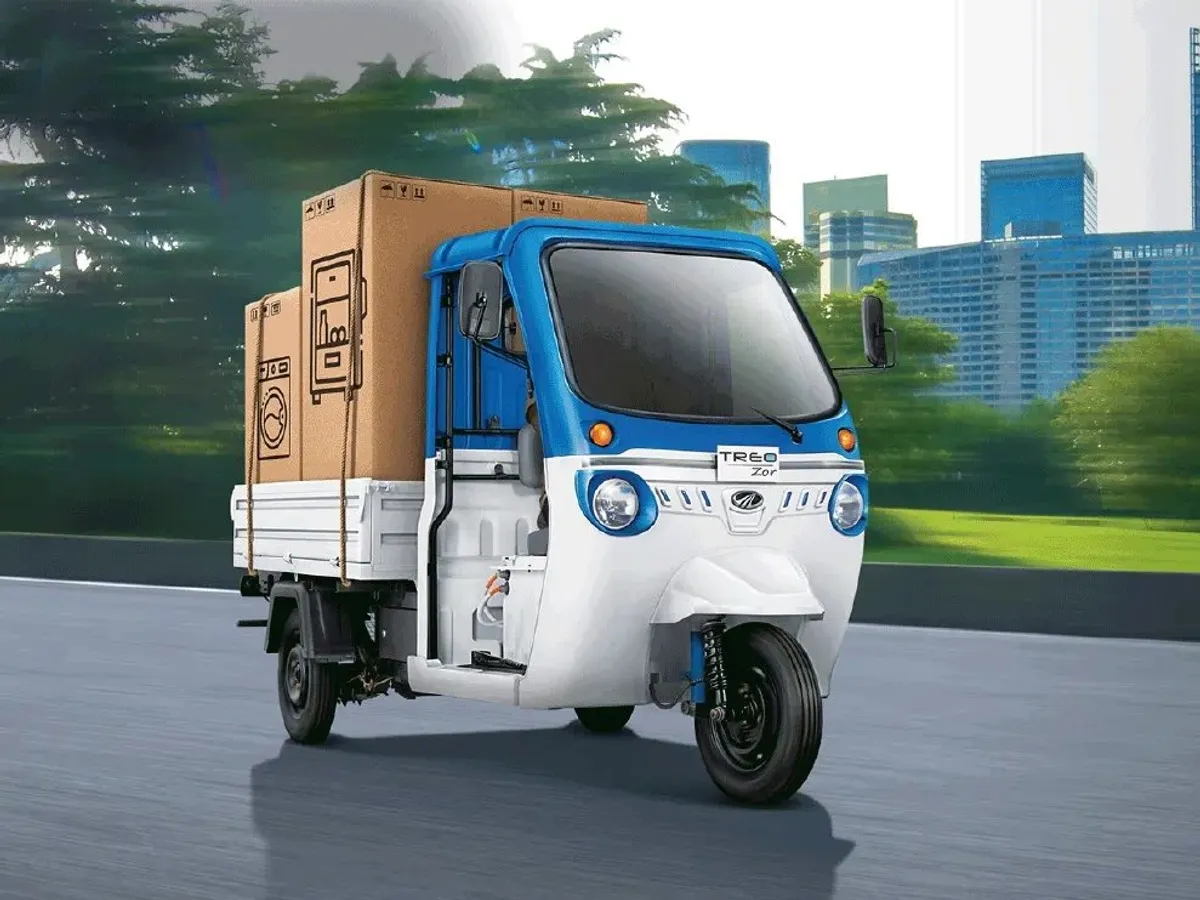
Mahindra Last Mile Mobility (MLMM) held third position in the e-SCV category with 285 units of the Mahindra Zeo, up 70% YoY. The Zeo’s 160 km range, backed by a 7-year or 1,50,000 km battery warranty and a service network exceeding 850 touchpoints, continues to resonate with fleet operators who prioritise total cost of ownership and after-sales support over headline specifications.
Switch Mobility, Ashok Leyland’s EV arm, sold 82 e-SCVs in April, up 134% YoY, rounding out a competitive top four. The Murugappa Group’s Tivolt Electric Vehicles, marketed under the Montra brand, delivered 81 units, a 710% YoY surge off a low base, and launched two new Eviator variants in April: the Eviator 350 at Rs 14.58 lakh and the Eviator 350L+ at Rs 16.86 lakh, with the latter targeting intercity and refrigerated transport with a 300 km certified range.
What Comes Next
The structural case for e-SCV growth in India is multi-layered and durable. The hub-and-spoke model that powers urban logistics in India’s top 30-40 cities is inherently suited to small electric cargo vehicles, with fixed routes, predictable distances, depot-based overnight charging, and high daily utilisation that maximises the fuel cost savings EVs deliver.
With CY2026 on track for 20,000-plus units, the segment’s next milestone is establishing consistent profitability across OEMs, not just volume leadership. Several players in the nearly 40-strong competitive field are operating on thin margins, and a shakeout that consolidates the market around four to five scaled operators seems likely over FY2027-FY2028.
The risk to the growth trajectory is primarily supply-side: battery cell availability and semiconductor procurement remain partially import-dependent. A sustained worsening of global supply chains could compress margins and extend delivery lead times, particularly for smaller OEMs without deep procurement relationships.
For market leaders Tata Motors, Euler Motors, and Mahindra, the strategic window is now. Capturing fleet operator loyalty early, building robust service networks, and locking in large e-commerce and FMCG fleet contracts will determine who emerges as the dominant platform in what is shaping up to be India’s fastest-growing EV segment.