
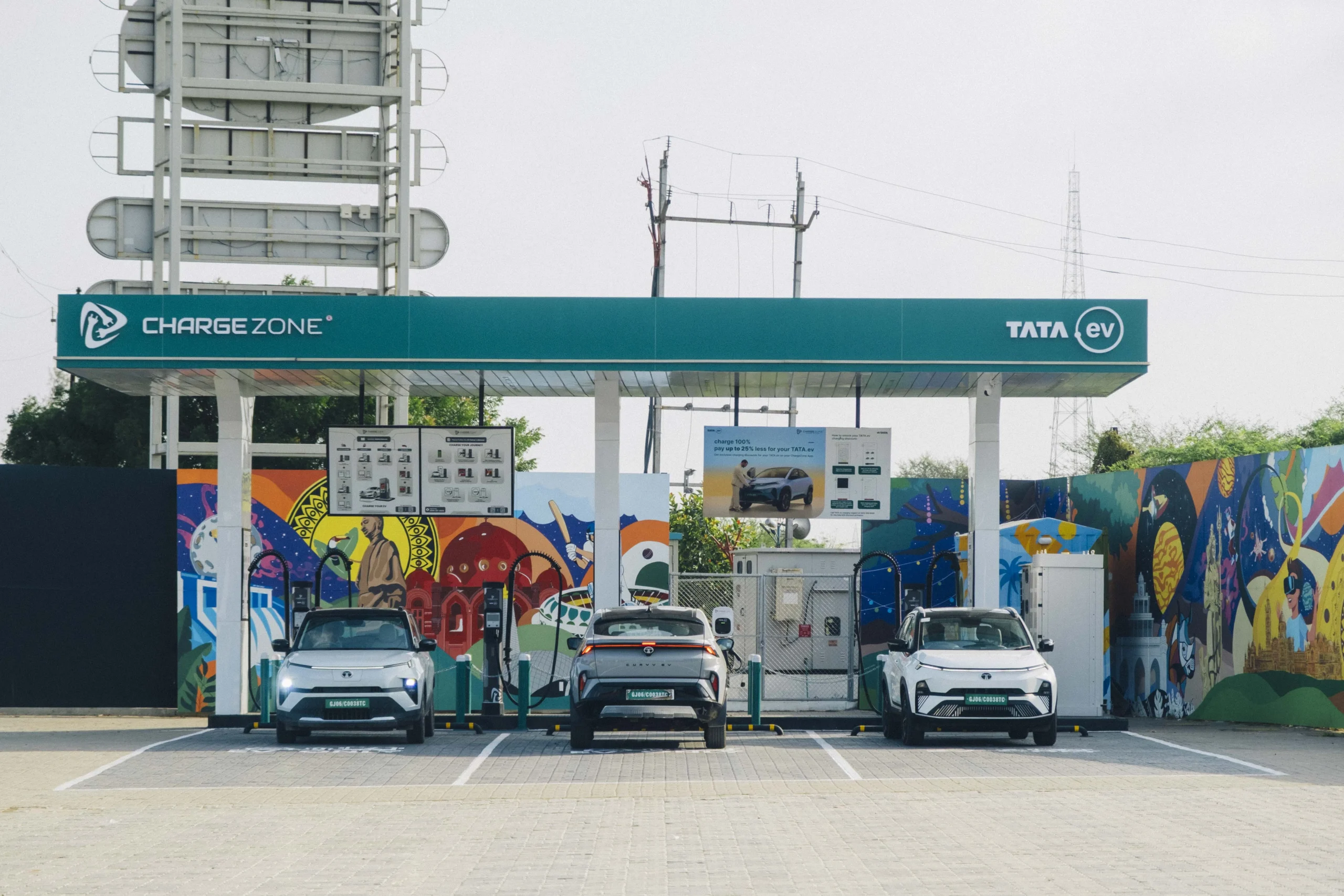
India’s electric vehicle market registered 2.3 million units in 2025, an 18% increase over 2024, and EVs now account for 8% of all new vehicle registrations in the country. The public charging network, in response, has expanded at a pace that sounds impressive in isolation: from approximately 5,000 stations in 2022 to around 39,500 by late 2025, a near-sixfold increase in three years. The problem is that EV adoption grew faster. The charger-to-EV ratio today stands at roughly one public charger per 235 electric vehicles. The global benchmark is one charger per 6 to 20 vehicles. India is not closing that gap. It is widening it.
To put the 2030 target in plain terms: the Confederation of Indian Industry estimates India will need 1.32 million public charging stations to support the government’s goal of 30% EV penetration by 2030. That is more than 40 times the current installed base, requiring the addition of over 400,000 new chargers every year for the next five years. India has never come close to that installation rate in any single year.
Policy Momentum
The policy framework behind India’s charging infrastructure build-out is genuinely ambitious. The PM E-DRIVE scheme, notified in September 2024 with a total outlay of Rs 10,900 crore, allocates Rs 2,000 crore specifically for public charging infrastructure, targeting 72,300 new chargers across 50 national highway corridors and high-footfall public locations including metro stations, airports, bus depots, and fuel stations. The breakdown covers 22,100 DC fast chargers for four-wheelers, 1,800 chargers for electric buses, and 48,400 chargers for electric two- and three-wheelers.
For context, the predecessor FAME-II scheme supported approximately 9,300 chargers over five years. PM E-DRIVE targets more than seven times that number in two years.
There is, however, a significant gap between the policy and the execution. Parliamentary data confirmed that zero expenditure had been incurred under PM E-DRIVE’s charging component as of March 2026, despite the Rs 2,000 crore allocation having been in place since October 2024. The scheme’s deadline has since been extended, and BHEL has been appointed as the nodal agency to aggregate charger demand and develop a unified EV super-app for real-time charger discovery, booking, and payment tracking. The intent is clear. The implementation timeline is not.
The FAME-II record is instructive here. Of 9,332 chargers sanctioned under FAME-II, only 6,645 were operational by March 2026, a 71.2% operationalisation rate. Nearly 29% of sanctioned chargers never became functional chargers, due to persistent challenges around site acquisition, grid connectivity, equipment procurement, and commissioning timelines. That execution gap, if it carries forward into PM E-DRIVE deployment, would reduce the effective output of the Rs 2,000 crore allocation significantly.
The Three Problems That Numbers Cannot Hide
Problem 1: Geography. India’s charging infrastructure is heavily concentrated. Karnataka alone leads the country with 6,097 stations, but approximately 85% of those are clustered in Bengaluru, leaving the rest of the state underserved. Delhi and Maharashtra lead urban deployment, but 55% of all charging stations nationally are concentrated in the top five states. Tier-3 and non-metro areas have, for the first time, overtaken Tier-1 cities in total charger count at 12,040 versus 9,702, but this aggregate figure obscures a quality gap: chargers in smaller towns are disproportionately slow AC chargers with unreliable grid connections, not the DC fast chargers that make public charging practically viable for four-wheelers.
Problem 2: Reliability. The number of installed chargers is not the same as the number of usable chargers. Approximately 18% of nationally installed stations were non-operational in March 2026 data. BPCL’s network has reported non-functional rates of up to 60% at some locations. The causes are systemic: grid voltage fluctuations, low utilisation undermining the economics of maintenance, payment gateway failures, and weak operator service models. A Delhi-to-Jaipur EV trip encountering missing or non-functional chargers is not an anecdote from 2022. It is a reported experience from 2026.
Problem 3: Viability. The average utilisation rate of India’s public charging stations currently sits at approximately 5%. For a charging station to break even within four to five years, utilisation needs to reach 10-12%. At 5%, investors face extended payback periods that make new station deployment a difficult capital allocation decision without subsidy support. A well-located DC fast charging station with co-located amenities, cafes, restrooms, and convenience access can achieve 30-40% higher utilisation than a standalone charger, but these configurations require more upfront investment and better site selection than the current rollout has consistently delivered.
The Home Charging Gap
India’s public charging problem is compounded by a structural weakness in home charging access. In mature EV markets, up to 80% of charging occurs at home, which significantly reduces the load on public networks. In India, only around 55% of EV owners currently have home chargers, the lowest rate among comparable EV markets.
The constraints are regulatory and physical. Delhi’s EV policy mandates that 20% of parking in new buildings be EV-ready. Maharashtra requires one charger per five parking spots in new projects. Uttar Pradesh mandates at least one charger for large residences. But enforcement is uneven, most states lack EV-ready building codes entirely, and existing housing complexes face prohibitive costs and coordination challenges to retrofit charging infrastructure. Until home charging access reaches 70-80% penetration, the pressure on public networks will remain disproportionately high relative to the number of EVs on the road.
Who Is Actually Building the Network
Despite the execution challenges, private capital has been moving. Tata Power operates the largest all-round public and fleet charging network with 6,700-plus points across 630-plus cities. Statiq has grown to 8,000-plus chargers across 70 cities and raised USD 18 million for DC fast charging expansion. Jio-bp Pulse operates 6,000-plus points across 75-plus cities with a focus on fast charging, claiming over 95% uptime. Bolt.Earth operates the largest distributed network at over 1 lakh chargers across 1,900-plus cities, though this spans home, semi-public, and peer-to-peer infrastructure rather than classic public fast charging.
On the public sector side, the oil marketing companies hold a structural advantage through their existing forecourt real estate. IndianOil claims 13,614 chargers, BPCL reports 6,563, and HPCL counts 5,400-plus. Their forecourt locations along national highways and in urban commercial zones are exactly where fast chargers deliver the highest utilisation and the strongest ROI, making OMC-operated networks one of the most commercially viable models in the current ecosystem.
Ather Grid leads the two-wheeler fast charging category with 5,000-plus fast chargers across 395-plus cities, a segment that is often overlooked in infrastructure discussions but serves the highest-volume EV category in India.
What Comes Next
The interoperability problem is the most structurally urgent issue facing India’s charging ecosystem in 2026. Too many operators run separate apps, separate access systems, and separate payment rails, creating a fragmented user experience that discourages EV adoption at the margin. The government’s plan to develop a unified EV super-app through BHEL, integrating real-time charger discovery, slot booking, and digital payments across networks, is the right structural intervention. Its effectiveness will depend entirely on how many operators actually integrate into the platform and how quickly.
The highway corridor gap is closing, but unevenly. Tamil Nadu is the only state where roughly 90% of chargers sit within 1 km of a highway. Nationally, 91% of highways now have a fast charger within 50 km, which makes most inter-city routes theoretically navigable in an EV. The operative word is theoretically: a charger within 50 km of a highway means little if it is non-functional, inaccessible, or incompatible with the vehicle’s connector standard.
India’s EV adoption story is moving faster than its charging infrastructure story. The gap between those two curves is not a failure of ambition. It is a failure of execution, coordination, and the boring but essential work of keeping chargers operational, funded, and interoperable once they are installed.
The Rs 2,000 crore under PM E-DRIVE, when it is actually deployed, will add meaningful capacity. The real test is whether the next 72,000 chargers work reliably after they are installed, and whether the ones already on the ground are available when drivers need them.